Opener Hums but the Garage Door Will Not Move
A few safe checks can tell you whether the problem is power, the sensors, the release handle or something that needs a technician.
October 14, 2026 · 4 min read
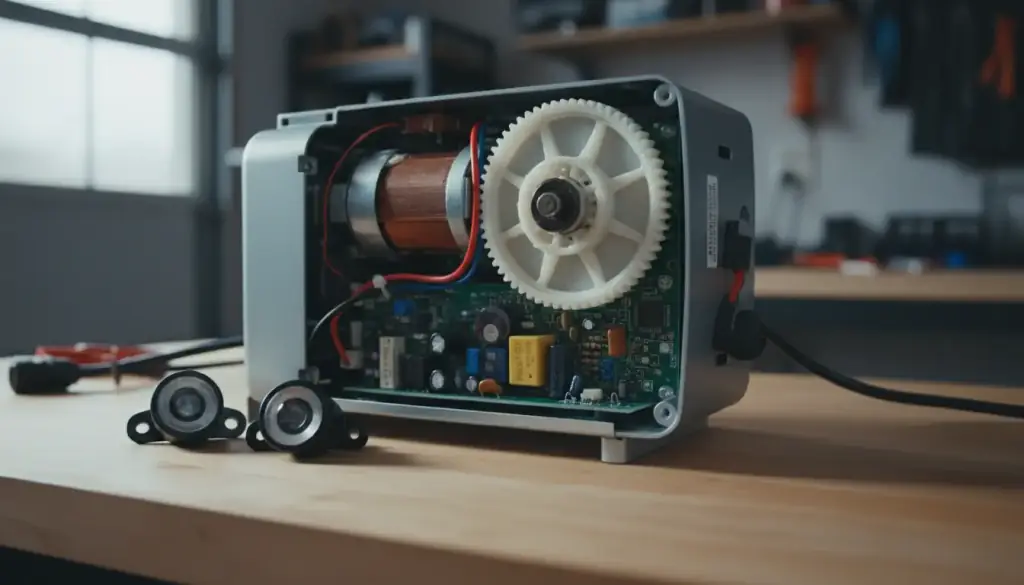
A hum with no movement is one of the more unsettling sounds a garage can make. The motor is clearly working, the light may even be on, and the door sits there. Or maybe it starts to close, thinks better of it, and climbs back up while you stand in the driveway wondering what you did wrong.
Some causes of this are simple and take a minute to fix. Others involve parts under tension that nobody should touch without training. This guide separates the two, so you can check what is safe to check and recognize when it is time to call.
Start with what the sound is telling you
Listen before you press anything else. A hum or a grinding whir with no movement usually means the motor is getting power but its force is not reaching the door. That can mean a worn drive gear, a trolley that has been disconnected, or a door that is too heavy for the opener to lift. A single click with nothing else points toward the control board. Complete silence and a dead wall button point toward power.
Each of those leads somewhere different, which is why guessing and pressing the button repeatedly tends to make things worse.
Checks you can safely make yourself
These need no tools beyond a stepladder and a rag, and none of them involve springs or cables.
- Power: confirm the opener is plugged in, try another device in the same outlet, and check the breaker or any outlet with a reset button.
- Wall control: many have a lock or vacation setting that tells the opener to ignore remotes. Check that it is not switched on.
- Remote: replace the battery before assuming the remote is dead.
- Release handle: the red cord hanging from the trolley disconnects the door from the opener. If someone pulled it, the motor runs and the door does not follow. Your opener's manual shows how to reconnect it.
- Track and door path: look for something wedged in the track or leaning against the door.
- Photo-eyes: look at the small sensors on each side of the door near the floor. Both should show a steady light. Wipe the lenses and make sure neither has been bumped out of line.
When the door reverses just before it closes
A door that heads down and then goes back up is doing what it was built to do: it thinks something is in the way. Two things cause this most often. The first is the photo-eye pair. Dirt on a lens, a bracket nudged by a bike, low sun hitting a sensor, or a wire pinched at a staple can all break the beam. A blinking light on one sensor is the clue.
The second is the opener's travel or force setting, which tells it when the door has reached the floor. If it is set wrong, the opener reads the floor as an obstruction. Adjusting those settings is reasonable for a technician. It is also easy to overcorrect, which leaves a door that no longer stops for a child or a pet.
Please do not tape over a sensor, unplug it, or hold the wall button down to force the door shut. Those safety features exist because a closing door is heavy. If you find yourself needing a workaround to close the door, the door needs a service visit.
Why a technician checks the door before the opener
Here is something that surprises people. Many openers that seem to have failed are actually fighting a door that is out of balance. A door with a tired or broken spring is far heavier than the opener was ever meant to lift, and the opener's gear takes the punishment. Replace the opener and the new one fails the same way.
So the first thing a trained technician does is check the door's balance with the opener disconnected. If the door is the problem, the spring side gets fixed. If the door is fine, the work moves on to the sensors and wiring, the logic board, the drive gear and sprocket, the trolley, and the travel limits. We do not recommend you run this test yourself if the door is heavy or was making noise before it stopped, because a door without working springs can drop.
What needs a technician
- A worn or stripped drive gear or sprocket, which causes the hum with no movement.
- A logic board that clicks, blinks or ignores commands.
- Any sign of a broken spring, frayed cable, or a door that sits crooked.
- A bent track section or a door that binds as it travels.
- Sensors that stay dim or blinking after you have cleaned and checked them.
- A remote that only works from a few feet away after a fresh battery.
The goal is a repair when a repair makes sense and a replacement opener when it does not. A malfunctioning opener is more than an annoyance. It can be downright unsafe, which is why we test auto-reverse and the photo-eyes before we leave every opener job.
Getting it looked at
Tri-County Door Doctor repairs openers for homes and businesses in Peoria, East Peoria, Dunlap, Pekin, Washington, Metamora and Germantown Hills. Our opener repair page is at /garage-door-opener-repair, and you can call (309) 357-3907 Monday through Friday, 8:00 am to 5:00 pm, or ask for a weekend appointment. If you send a callback request instead, a representative contacts you the same business day.
Tri-County Door Doctor, (309) 357-3907
Call (309) 357-3907More articles
That Bang in the Garage Was Probably a Torsion Spring
A sharp crack from the garage, then a door that will not lift: here is what failed and what to do until a technician arrives.
A Garage Door Maintenance Checklist for Central Illinois Winters
One careful look each fall catches the small problems before freezing weather turns them into a door that will not open.