A Garage Door Maintenance Checklist for Central Illinois Winters
One careful look each fall catches the small problems before freezing weather turns them into a door that will not open.
October 14, 2026 · 4 min read
Central Illinois winters ask a lot of a garage door. Wet snow packs against the bottom edge, freeze and thaw cycles stiffen rubber, and a door that squeaked a little in September can be a door that will not move in January. The garage door is also the largest moving thing in most homes, so small problems matter more than they look.
A fall check takes about as long as raking one corner of the yard. Here is a checklist you can follow, with clear marks for the parts that belong to a technician.
Start by watching and listening
Stand inside the garage and run the door through a full open and close. Watch the travel and listen. New noises are the earliest warning you get: grinding, popping, scraping, a squeal that was not there last year. Notice whether the door moves evenly or one side seems to lead the other, and whether it slows down or shudders anywhere in its travel. Write down what you see. It is useful to hand to a technician later.
Check the weather seal and the bottom edge
The rubber seal along the bottom of the door keeps out cold air, water, leaves and pests. Over the seasons it hardens, cracks, or curls at the corners. Close the door in daylight and look from inside. If you can see a line of light along the floor, or a gap at the corner, the seal is not doing its job. Also look at the door's side and top weatherstripping for tears or gaps.
A bottom seal that has frozen to the slab is a winter classic. If your door sticks to the concrete in freezing weather, do not keep pressing the button. The opener can strain or tear the seal. Clear the ice first, and if it keeps happening, the seal or the slope of the floor is worth a look.
Hardware to inspect and what to lubricate
With the door closed, look over the visible hardware. You are looking, not adjusting.
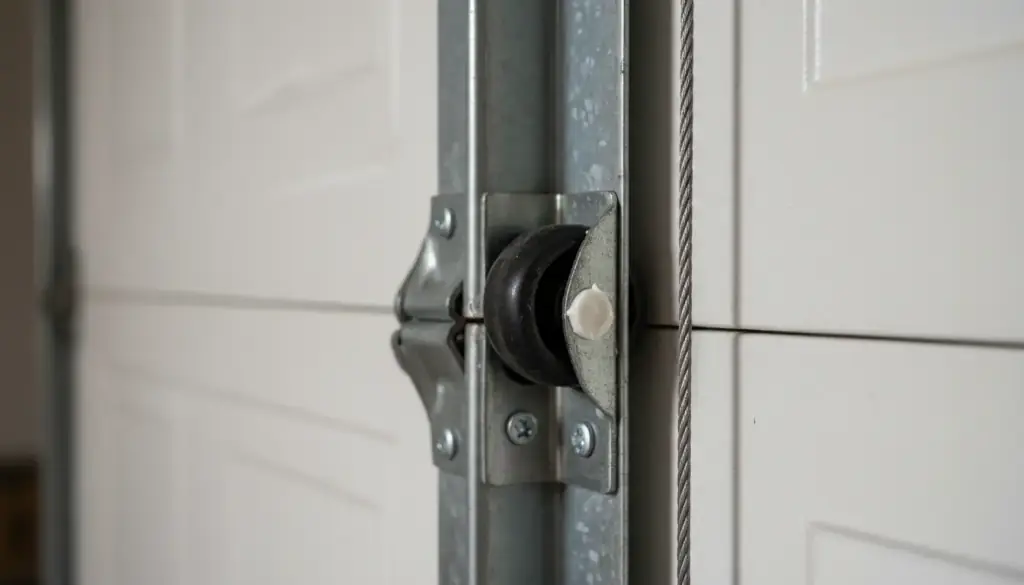
- Rollers: they should turn smoothly in the track. Steel rollers can be lubricated at the bearings. Cracked or flat-spotted nylon rollers should be replaced.
- Hinges: look for cracks and loose screws. A little garage door lubricant on the pivot points helps.
- Track: check that it is straight, clean and firmly bolted to the wall. Wipe out dirt, but do not grease the track. Grease gathers dust and gums up the rollers.
- Cables: look for frayed strands, rust or kinks. If you see damage, do not touch them. Call.
- Springs: look at the coil above the door for gaps or rust. Do not adjust, wind or remove springs yourself.
- Fasteners: tighten loose bolts on hinges and brackets that are not part of the spring or cable system.
Run the balance test
A balanced door means the springs are carrying the weight, so the opener only has to guide the door. To test it, close the door and pull the red release handle to disconnect the opener. Lift the door by hand to about the halfway point and let go carefully. A balanced door stays put or drifts only slightly. One that falls or flies upward is out of balance.
Only do this if the door has been working normally. If it feels heavy, makes new noise, or you have seen a gap in the spring, stop, lower it slowly and call. An out-of-balance door wears out the opener and can be unsafe, but the fix is spring adjustment, which is work for a technician, not a weekend project.
Test the safety reverse
Two quick tests tell you whether the door will stop for a person, a pet or a bike. For the first, set a flat piece of lumber or a rolled towel on the floor in the door's path and close the door with the remote. When the door touches it, the door should stop and reverse. If it stays down on the obstruction, the opener's force setting is wrong.
For the second, start the door closing and wave a broom handle through the beam between the photo-eyes. The door should stop and go back up. If either test fails, stop using the door for daily closing and have it looked at. This is a safety system, and it is not worth gambling on.
When to call a professional
A professional maintenance visit covers what a homeowner should not do: spring and cable inspection under proper tools, balance adjustment, opener force and travel settings, photo-eye alignment, and a safety check at the end. Regular maintenance helps find problems early and prevents the sort of equipment failure that can injure someone or damage a vehicle.
Details on what we cover are on our maintenance page at /garage-door-maintenance. Call Tri-County Door Doctor at (309) 357-3907 and we will schedule a visit anywhere in Peoria, East Peoria, Dunlap, Pekin, Washington, Metamora or Germantown Hills. Our hours are Monday through Friday, 8:00 am to 5:00 pm, with weekends by appointment.
Tri-County Door Doctor, (309) 357-3907
Call (309) 357-3907More articles
That Bang in the Garage Was Probably a Torsion Spring
A sharp crack from the garage, then a door that will not lift: here is what failed and what to do until a technician arrives.
Opener Hums but the Garage Door Will Not Move
A few safe checks can tell you whether the problem is power, the sensors, the release handle or something that needs a technician.