That Bang in the Garage Was Probably a Torsion Spring
A sharp crack from the garage, then a door that will not lift: here is what failed and what to do until a technician arrives.
October 14, 2026 · 4 min read
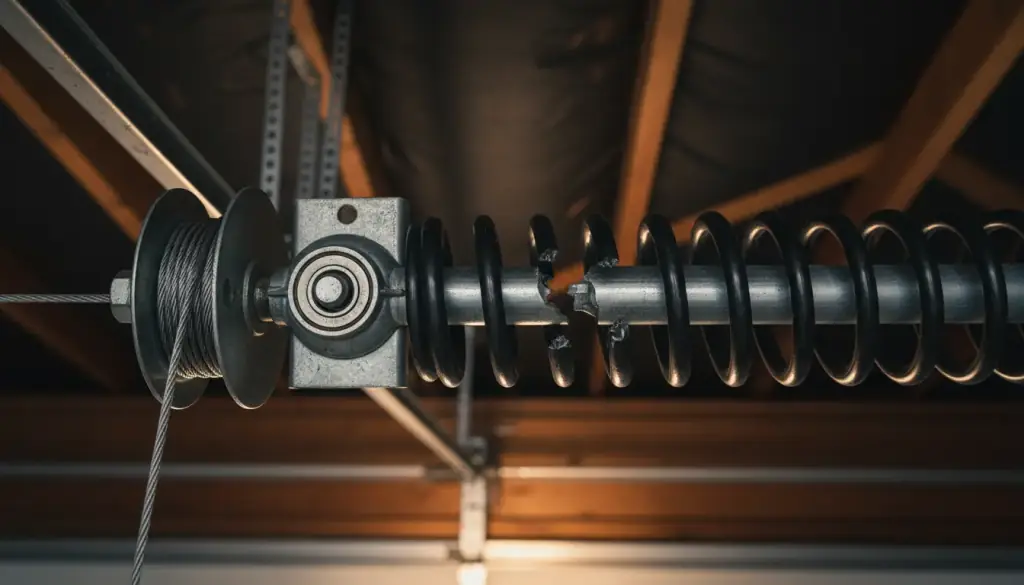
You're in the kitchen, or just about to fall asleep, and a sharp crack comes from the garage. It sounds like a firecracker or a dropped toolbox. Nothing seems to have fallen, so you tell yourself the house was settling. Then the next morning the door will not lift, or it rises a few inches and quits.
That bang is very often a torsion spring letting go. This article explains what happened, what you can safely do in the meantime, and what a repair visit looks like, so you know what to expect before you pick up the phone.
What a torsion spring actually does
A residential garage door is heavy. A steel sectional door is heavy, and an insulated or wood one is heavier. Your opener was never meant to carry that weight. The spring does. On many sectional doors, a torsion spring is mounted on a steel tube above the opening, with a cable drum at each end. When the door closes, the spring winds tighter and stores energy. When the door opens, the spring unwinds and helps lift, so the door feels light in your hand and the opener only has to guide it.
Every open and close flexes the spring. Over the years the metal tires, and one day it fractures. When it does, all that stored energy releases at once. That is the bang you heard.
Signs it was a spring and not something else
Not every loud noise in a garage is a spring. These are the signs that point to one:
- A loud crack from the garage with nothing visibly fallen.
- A gap in the coiled spring above the door, where the two halves have separated.
- An opener motor that runs while the door barely moves, or a door that lifts a few inches and stops.
- A door that feels very heavy when you try to lift it by hand with the opener disconnected.
- A lift cable hanging loose, or one that has jumped off its drum.
- A door that sits crooked in the opening.
Some older doors use extension springs that run along the tracks on each side instead. The idea is the same: a snapped one usually leaves a visible break and a door that will not stay up. Any one of these signs is reason enough to stop and call. Several together make it close to certain.
Why you should stop running the opener
It is tempting to press the button one more time to see if it works. Please don't. With a broken spring, the opener is suddenly trying to lift the full weight of the door by itself. Its gear and motor are not built for that, so you risk burning out the opener on top of the spring problem. A door that jerks up and drops can also come down crooked, bend a section, or pull a cable off its drum.
If the door is stuck closed, leave it closed and call. If it is stuck partway open, do not walk under it and do not try to force it down. A door with a broken spring can fall fast, and the person who gets hurt is usually the one who was only trying to get the car out.
Leave the spring and the cables alone
This is the one part of garage door work we ask every homeowner to skip. A wound torsion spring holds a great deal of stored force. The bolts on the winding cones and the brackets at the bottom corners of the door, where the cables attach, are under tension. A slipped winding bar or a loosened bolt can send metal flying hard enough to cause serious injury.
Do not try to adjust, unwind, remove or replace springs or cables yourself, and do not order parts online and plan to do it on a Saturday. Tools, training and the right size of spring all matter here, because a spring that does not match the door's weight and height will never balance it properly.
What a repair visit looks like
When you call Tri-County Door Doctor about a bang like this, a technician arrives on time to look at the door, assess what actually failed, and come up with a plan of action before work begins. A broken spring rarely travels alone, so the visit usually covers more than one part.
- Finding the break and checking what else it affected: cables, drums, bearing plates and the center bracket.
- Matching a replacement spring to the door's weight and height.
- Replacing cables or drums that show wear while the system is already unwound, so you are not calling again next month.
- Winding the new spring and testing balance with the opener disconnected. A balanced door stays where you leave it at about the halfway point.
- Lubricating moving parts, reconnecting the opener, and testing that the door reverses when it meets an obstruction.
On wider doors, springs often work as a pair. If one has broken, the other has had exactly the same use, so it is fair to ask the technician what condition it is in.
Who to call around Peoria
If you heard that bang, start with our garage door repair page at /garage-door-repair or call (309) 357-3907. We answer Monday through Friday, 8:00 am to 5:00 pm, with weekends by appointment, and we serve Peoria, East Peoria, Dunlap, Pekin, Washington, Metamora and Germantown Hills. Tri-County Door Doctor has been family-owned and local since Chip Wilmot founded it in 2015.
Tri-County Door Doctor, (309) 357-3907
Call (309) 357-3907More articles
Opener Hums but the Garage Door Will Not Move
A few safe checks can tell you whether the problem is power, the sensors, the release handle or something that needs a technician.
A Garage Door Maintenance Checklist for Central Illinois Winters
One careful look each fall catches the small problems before freezing weather turns them into a door that will not open.